

 くらし・総合
 こども・子育て
 魅力・イベント
 事業者
事業者 市政情報
市政情報 防災・防犯・安全
KAWASAKI NATURE LOOP Global Platform
- 公開日:
- 更新日:
ページ内目次
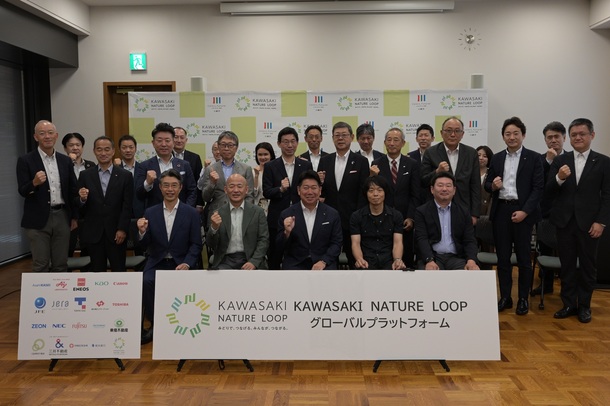
On July 8, 2026, Kawasaki City and 19 other entities—including global corporations—established the "KAWASAKI NATURE LOOP Global Platform," a new collaborative framework aimed at building an urban model centered on the "visualization" of greenery and biodiversity.
Formulation Objectives
As a kickoff to promote initiatives such as developing a framework for Midori Management and visualizing data, and in light of the global trend toward corporate disclosure of nature-related information as well as ongoing national efforts to develop methods for valuing biodiversity, the City has established the “KAWASAKI NATURE LOOP Global Platform.”
This platform serves as a new forum centered on globally active companies located in the city. We have initiated the following discussions in order to drive future initiatives:
- Visualization of greenery and biodiversity
- Implementation of monitoring methods
- Examination of indicators
- Exchange of views on other topics related to the connectivity and clustering of greenery
Background
▶Holding the National Urban Greenery Kawasaki Fair(2024)
As a symbolic project marking the 100th anniversary of municipal government, the National Urban Greenery Kawasaki Fair was held in two phases (autumn and spring) during FY 2024 (Reiwa 6). The fair’s theme, “Connecting through midori. Connecting everyone,” aimed to achieve a city that is connected by midori and remains easy and desirable to live in.
By combining Kawasaki’s diverse attractions with midori, opportunities and awareness were created for people to discover and incorporate midori into everyday life through various initiatives, such as showcasing the diverse functions and benefits of midori and proposing new ways to utilize parks. Simultaneously, citizens, companies, organizations, schools, and many other participants worked together to create flowerbeds at the venues, allowing “Kawasaki-style midori” to be shared nationwide and generating numerous new connections through midori.
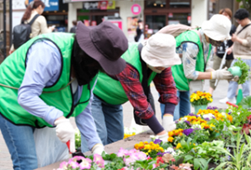
Collaborative Flower Bed Creation
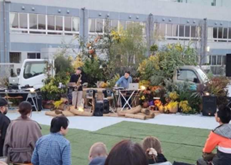
A festival held through co-creation
▶Formulating the “Future Midori Vision” as a legacy (March 2026)
・While taking global trends into account, the fair served as an opportunity to formulate a future vision that presents the direction to aim for over the next 100 years.
・This “Future Midori Vision” sets out the desired state for 2050 as an overarching concept guiding related individual plans. It envisions Kawasaki as a city where diverse stakeholders independently develop 3 key pillars: “Green Connections”, “Human Connections”, and “Urban Development that Utilizes”, thereby maximizing the value of greenery and fostering a virtuous cycle in which nature and the city continue to grow together.
・To sustain the growth and virtuous cycle of these 3 pillars, it is essential for a wide range of stakeholders—citizens, businesses, organizations, universities, financial institutions, etc.—to participate voluntarily and take proactive action. Accordingly, the city will promote the development of Midori Management mechanisms to advance and expand initiatives comprehensively across the entire city. At the same time, it will disseminate information and raise awareness through various opportunities. In terms of “connections through greenery”, efforts will include collaboration among various stakeholders to conduct current condition surveys and monitoring, collect baseline data on green coverage and flora and fauna, and visualize such data, thereby promoting initiatives toward realizing the future vision.
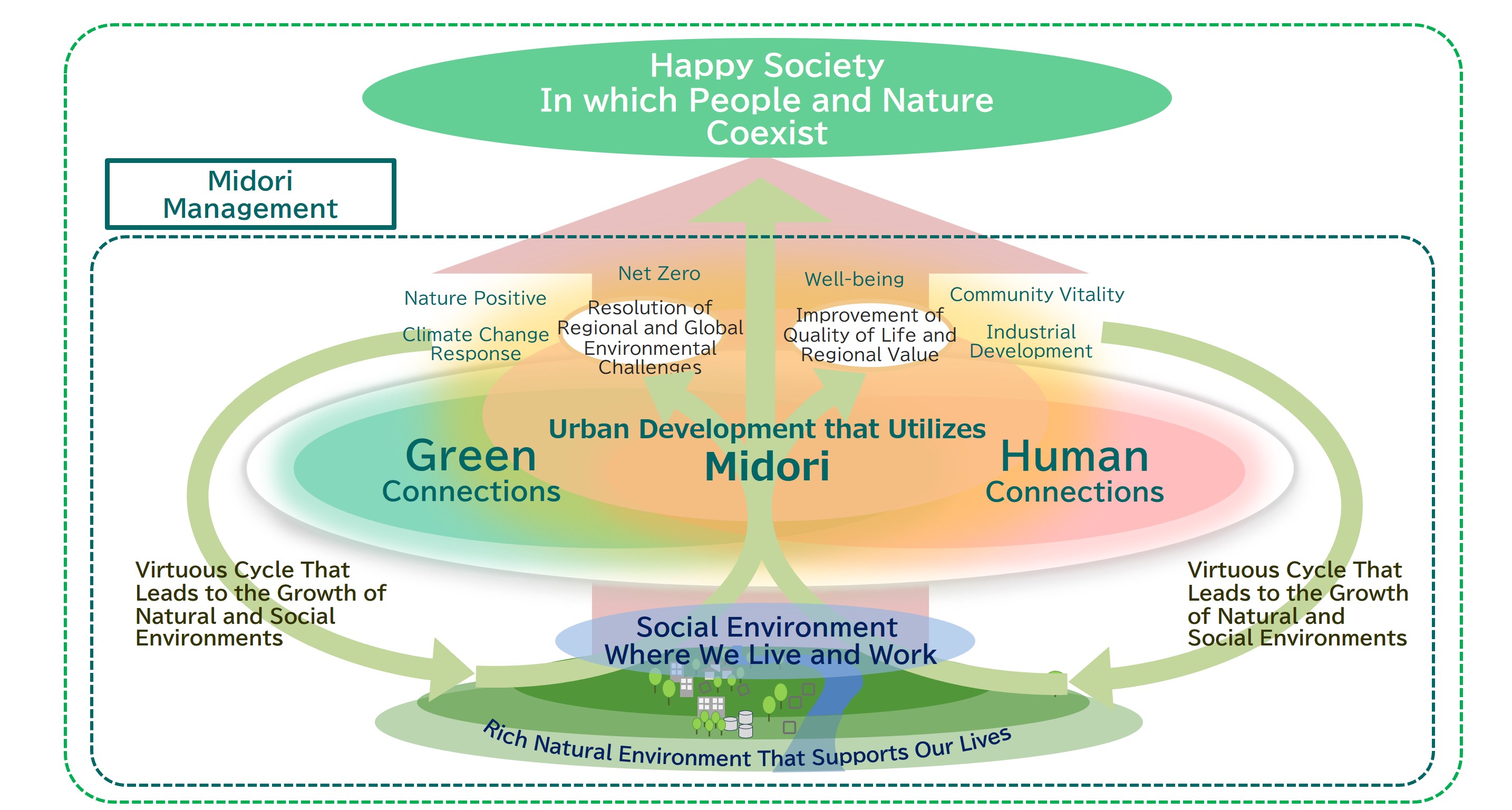
Image of a Sustainable Virtuous Cycle in which Nature and Cities Grow Together
Approach
To advance efforts in collaboration not only with the government but also with diverse stakeholders that form the Kawasaki community, and to contribute to nature-positive outcomes while living in harmony with nature, the City will promote initiatives as follows:
- As a kickoff toward realizing the “Future Vision for Greenery,” the City will begin discussions under a new framework with businesses, particularly globally active companies located in the city, to lead future initiatives.
- The City will establish a platform as a venue for collaboration with businesses and promote initiatives such as the visualization and monitoring of greenery and biodiversity. These efforts aim to advance nature-positive outcomes in a way that can receive global recognition.
- The outcomes of these discussions will be used to foster broader, integrated initiatives involving diverse stakeholders such as citizens, businesses, organizations, universities, and financial institutions. They will also help raise awareness within the city and support timely communication of these efforts both domestically and internationally.
Role of the City
- As global trends increasingly emphasize not only decarbonization but also biodiversity, the role of the City is becoming more important than ever in embedding these movements within Kawasaki from a local perspective.
- Kawasaki City needs to take the lead in guiding greening efforts through a combination of regulation and incentives, creating opportunities that foster connections among stakeholders, and enhancing the quality of greenery in ways that reflect local characteristics.
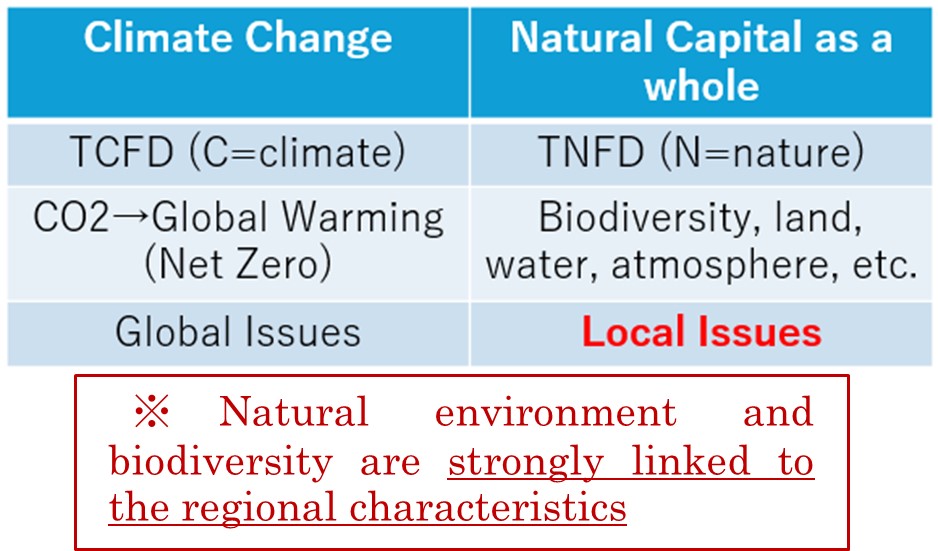
Global Trends in Environmental Issues
Expected Roles of Businesses
- Businesses are increasingly advancing efforts related to nature-related disclosures, in line with global trends such as the Taskforce on Nature-related Financial Disclosures (TNFD) and ESG investments.
- Going forward, in addition to conventional greening and conservation activities, businesses are expected to engage in biodiversity-conscious greening, contribute to local communities, and leverage various technologies to enhance the functions and benefits of greenery. Through these efforts, they are expected to help create a virtuous cycle that is recognized globally.
Composition (Titles Omitted)
Intellectuals
- MORI Akira (Professor, Research Center for Advanced Science and Technology, University of Tokyo)
- UCHIDA Kei (Associate Professor, Faculty of Environmental Studies, Tokyo City University
Companies (in Japanese syllabary order)
Large-scale Enterprises
- Asahi Kasei Corp.
- Ajinomoto Co., Inc.
- ENEOS Corporation
- Kao Corporation
- Canon Inc.
- JFE Steel Corporation
- Toshiba Corporation
- TEPCO Power Grid
- Zeon Corporation
- NEC Corporation
- Fujitsu Limited
- Resonac Corporation
Real Estate
- TOKYU LAND CORPORATION
- NIPPON STEEL KOWA REAL ESTATE CO.,LTD.
- Mitsui Fudosan Co., Ltd.
Finance
- Kawasaki Shinkin Bank
- The Bank of Yokohama,Ltd.
Observer
- Association for Business Innovation in harmony with Nature and Community
Adviser
- HARAGUCHI Makoto ( Fellow, MS&AD Insurance Group Holdings, Inc.; Senior Advisor, Satisfactory)
- HORIE Ryuichi (CEO and Representative Director, CSR Design Green Investment Advisory, Co., Ltd.)
Key Directions for Discussion
(1)Visualizing Midori and Biodiversity
We aim to establish the “Kawasaki Model,” which utilizes the latest satellite remote sensing and geospatial information analysis technologies to quantify and visualize the effects of greening initiatives and activities in green spaces, tailored to the city’s distinctive landscape. Furthermore, by incorporating the results of field surveys and expert insights, we will enhance the accuracy of this model so that local companies’ biodiversity initiatives can be utilized for global recognition. This will help support sustainable corporate activities aimed at enhancing the city’s appeal, increasing regional value, and achieving nature-positive outcomes.
(2)Implementation of Monitoring Methods
By continuously conducting monitoring of the habitats and growth of flora and fauna within the city, the City will collect baseline data on greenery, including data on green coverage and biodiversity surveys. At the same time, it will work to develop sustainable monitoring methods that can serve as a model for urban areas. These methods will be established through collaborative surveys with diverse stakeholders, while also ensuring that initiatives carried out in partnership with local communities and businesses can be consistently communicated both domestically and internationally.
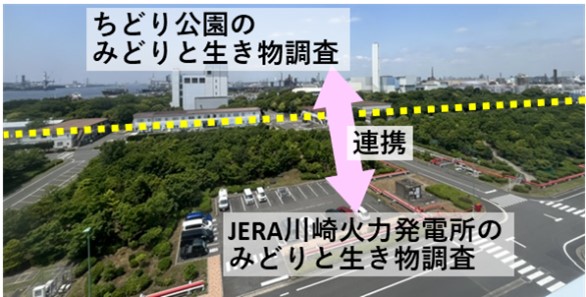
Corporate Partnerships
(Chidori Park & JERA Kawasaki Thermal Power Plant)
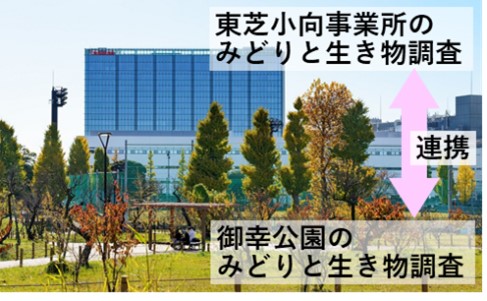
Corporate Partnerships
(Toshiba Corporation & MIYUKI PARK)
Community collaboration
(Yumemigasaki Zoological Park)
<Advancing Further Efforts in Visualization>
In preparation for the development of indicators, the City will further utilize the “Kawasaki Model” to take on new challenges. These include identifying priority areas for greening that contributes to biodiversity and conducting pilot initiatives to examine the visualization of well-being (physical and mental health) and resilience (enhanced capacity to withstand disasters and other risks).
Through these efforts, the City will work to establish a model that creates a virtuous cycle in which the urban environment and nature grow together.(3) Examination of Indicators
With a view toward the 2050 Future Midori Vision, the City will examine indicators appropriate for Kawasaki. This will be done while exchanging views on the visualization of greenery and biodiversity, as well as methods for promoting greening, and by aiming to visualize nature-positive outcomes.
Taking into account trends in international biodiversity-related indicators, and setting 2040 as the target year, which serves as an intermediate milestone toward the 2030 SDGs and 2050 net-zero (carbon neutrality) goals, the City will consider indicators that reflect elements such as the connectivity and clustering of greenery that contribute to biodiversity.
<Perspectives for setting future indicators, as outlined in the Future Midori Vision>
- Indicators showing the connectivity of greenery
- Indicators showing the clustering of greenery
- Indicators showing well-being (mental and physical fulfillment) in key areas
- Indicators showing collective efforts by the community
お問い合わせ先
Green Future Advancement Section Construction and Greenery Development Bureau Kawasaki City
Phone +81-44-200-0385
FAX +81-44-200-3973
Address Miyamoto-cho 1,Kawasaki-ku,Kawasaki-shi,Kanagawa 210-8577
mail 53grfuture@city.kawasaki.jp
コンテンツ番号188618
